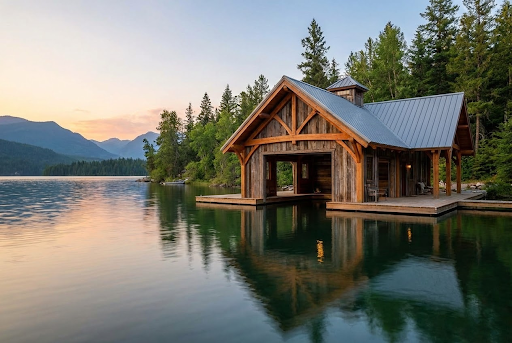
Waterfront property is valuable. Exposed boats, docks, and equipment are not. Sun, wind, fluctuating water levels, and constant moisture destroy finishes, weaken structural components, and shorten the lifespan of even high-end vessels. That’s where timber frame boat houses come in. When properly designed and engineered, they provide structural protection, architectural presence, and long-term durability that lightweight or prefabricated alternatives simply cannot match.
If you’re investing in a waterfront structure, cutting corners defeats the purpose. A well-built timber frame solution is not decorative—it’s structural, functional, and built to endure harsh shoreline conditions.
What Are Timber Frame Boat Houses?
Timber frame boat houses are heavy structural buildings constructed using large solid wood posts and beams joined through traditional mortise-and-tenon connections or engineered joinery systems. Unlike thin post structures or metal carports, a true heavy timber boat house uses substantial members designed to carry significant loads—roof weight, wind uplift, snow loads, and in some cases upper-level living or storage space.
The defining difference is structural mass. Heavy timbers resist movement, twisting, and long-term deformation far better than smaller dimension lumber. That stability matters over water, where humidity levels are consistently high and wind exposure is amplified.
Why Choose Custom Timber Boat Houses?
Standard, off-the-shelf structures rarely work well on waterfront properties. Shoreline elevations vary. Dock configurations differ. Local codes often impose strict setbacks, height limits, and environmental requirements. That’s why custom timber boat houses are the practical solution.
A custom design allows you to:
- Align rooflines with existing homes or lake cabins
- Accommodate single or multiple boat slips
- Integrate lifts, storage rooms, or upper decks
- Adjust post spacing to fit dock layouts
- Engineer for site-specific wind, snow, or seismic loads
Ignoring site conditions leads to expensive redesigns or structural compromise. Customization is not a luxury—it’s necessary for structural accuracy and code compliance.
Structural Strength That Matters
Waterfront structures face unique stresses. Wind moving across open water gains force. Waves create vibration. Moisture penetrates exposed materials year-round. Lightweight framing systems deteriorate quickly under these conditions.
Heavy timber performs differently.
Large beams and posts have higher load-bearing capacity and greater resistance to deflection. Traditional joinery systems distribute structural forces more effectively than metal brackets alone. Over time, properly fitted mortise-and-tenon joints can tighten as the wood naturally seasons.
This is why centuries-old timber structures still stand today. When engineered correctly, a heavy timber boat house can last for generations with proper maintenance.
Material Selection for Waterfront Durability
Not all wood species are suitable for marine environments. Selecting the wrong timber leads to premature decay and insect damage.
Common species used in timber frame boat houses include:
- Western red cedar for natural rot resistance
- Douglas fir for structural strength
- Cypress for moisture durability
These species contain natural compounds that resist fungal growth and insect infestation. However, species alone does not guarantee longevity. Proper finishing, sealing, and design detailing are critical.
End grain must be protected. Roof overhangs should extend far enough to shed water away from vertical posts. Hardware must be corrosion-resistant, particularly in saltwater environments where standard steel fasteners fail quickly.
Architectural Impact on Waterfront Properties
Function is mandatory. Aesthetics are strategic.
A poorly designed metal structure may protect a boat, but it can significantly reduce the visual appeal—and value—of a premium waterfront property. In contrast, custom timber boat houses add architectural depth and cohesion.
Exposed beams create visual warmth. Heavy timber posts frame lake views rather than obstruct them. Vaulted rooflines enhance openness and light flow. When designed to complement the primary residence, the boat house becomes an integrated extension of the property rather than an afterthought.
For high-value waterfront real estate, design alignment matters.
Multi-Use Capabilities
A well-designed heavy timber boat house can do more than shelter boats. Depending on engineering and local regulations, it may include:
- Upper-level entertaining decks
- Storage lofts for gear
- Enclosed rooms for equipment
- Integrated lighting and electrical systems
- Outdoor kitchen or seating areas
However, stacking additional functions increases load requirements. Structural calculations must account for live loads, roof loads, and environmental forces. If you plan to expand use beyond basic boat storage, design for it from the beginning. Retrofitting later is inefficient and costly.
Environmental Considerations
Waterfront construction often falls under stricter environmental regulations. Shoreline impact, runoff control, and foundation design must meet local permitting standards.
Timber offers an advantage when sourced responsibly. Wood is a renewable material with lower embodied energy compared to steel or concrete. When harvested from managed forests, it supports sustainable building practices.
That said, sustainability claims mean nothing without responsible sourcing and proper construction. A poorly maintained timber structure that fails early is not environmentally responsible. Longevity is the true sustainability metric.
Maintenance: What Property Owners Must Understand
Timber is durable—but it is not maintenance-free. Anyone promising “zero maintenance” is selling fiction.
To protect a heavy timber boat house, you must:
- Apply high-quality stains or sealants every few years
- Inspect for moisture intrusion and surface cracking
- Monitor joints and hardware annually
- Keep debris and standing water away from posts
- Address insect activity immediately
Neglect leads to surface deterioration, which eventually compromises structural integrity. Proper upkeep is straightforward but non-negotiable.
Cost vs. Long-Term Value
Heavy timber construction costs more upfront than lightweight alternatives. That’s reality. Larger materials, precision joinery, and engineering increase initial investment.
But compare life cycles.
Thin-framed or metal structures often require earlier replacement, corrosion repair, or structural reinforcement. Over decades, repeated repairs erase any upfront savings.
A properly engineered timber frame boat house provides structural longevity, architectural consistency, and property value enhancement. When amortized over decades, the cost difference narrows significantly.
Final Thoughts
If your goal is short-term coverage, a basic structure might suffice. If your goal is long-term protection, architectural integration, and generational durability, timber frame boat houses are the superior solution.
Custom engineering ensures the structure fits your shoreline conditions. Heavy timber framing delivers the strength required for waterfront exposure. Thoughtful design enhances both usability and visual impact.
Waterfront property demands more than minimal protection. A properly designed custom timber boat house is not just shelter—it’s structural insurance for your investment and a lasting extension of your home’s architecture.