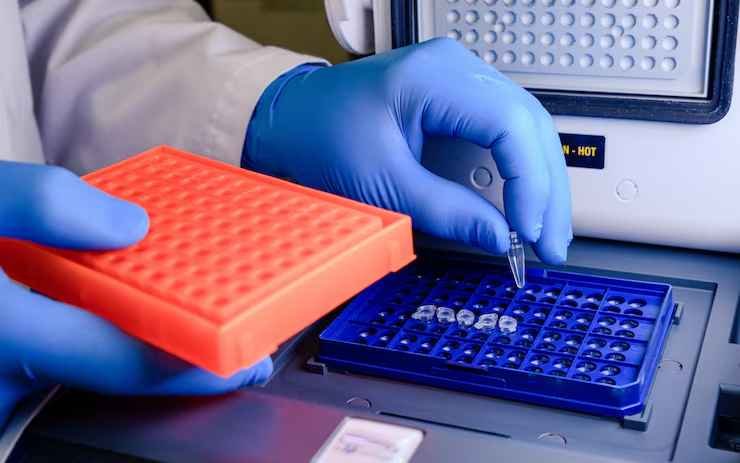
In modern biomedical research, the ability to detect and measure specific proteins with precision is fundamental. ELISA immunoassay kits — short for Enzyme-Linked Immunosorbent Assay — are among the most trusted tools in the laboratory toolkit, enabling researchers to quantify antigens, antibodies, hormones, and cytokines in biological samples with exceptional reproducibility.
From infectious disease diagnostics to drug discovery pipelines, ELISA-based detection has cemented its role as a cornerstone of modern life science research. But what exactly are these kits, how do they work, and why do researchers keep returning to them?
The Science Behind ELISA Technology
ELISA is a plate-based immunoassay technique that exploits the specificity of antigen-antibody interactions. A target molecule — the antigen — is immobilised on a solid surface (typically a 96-well microplate), and a detection antibody conjugated to an enzyme is introduced. When a substrate is added, the enzyme catalyses a colour change proportional to the amount of antigen present, which is measured using a spectrophotometer.
The sensitivity of this method can reach picogram-per-millilitre concentrations, making it suitable for detecting low-abundance biomarkers that would otherwise go undetected.
Major Types of ELISA Formats
Direct ELISA
In a direct format, the antigen is coated onto the plate and detected by a labelled primary antibody. This approach is simple and fast but offers lower sensitivity compared to other formats.
Sandwich ELISA
The sandwich format uses two antibodies — a capture antibody and a detection antibody — flanking the target antigen. This double-recognition step dramatically increases specificity and is widely used for cytokine and growth factor quantification in serum, plasma, and cell culture supernatants.
Indirect ELISA
Indirect ELISA employs an unlabelled primary antibody and a labelled secondary antibody. This format is common for measuring antibody titres in immunology research, particularly for evaluating vaccine responses.
Competitive ELISA
In the competitive format, the target analyte in the sample competes with a labelled antigen for antibody binding. As analyte concentration increases, signal intensity decreases. This inverse relationship makes competitive ELISA ideal for detecting small molecules and haptens.
Key Applications in Biomedical Research
ELISA immunoassay kits serve a remarkably wide range of scientific applications:
- Protein detection and quantification in cell lysates and biological fluids
- Biomarker analysis for disease monitoring and therapeutic response evaluation
- Cytokine and chemokine profiling in immunology studies
- Measurement of hormones and metabolic markers in endocrinology research
- Pharmacokinetic studies to track drug concentrations over time
- Food safety testing for allergens and contaminants
What Makes a High-Quality ELISA Kit?
Not all ELISA kits are equivalent. Researchers must evaluate several performance characteristics before selecting a kit for their specific application:
- Sensitivity: The lowest detectable concentration (lower limit of detection) the kit can reliably measure
- Specificity: The degree to which the kit distinguishes the target from structurally similar molecules
- Dynamic range: The linear quantification range within which results are accurately interpolated
- Cross-reactivity: How much the kit reacts with related proteins or species — critical in translational research
- Reproducibility: Consistent results across different lots, operators, and laboratory conditions
Sample Compatibility Considerations
Choosing the correct ELISA kit also depends on the biological matrix. Many kits are validated for serum and plasma, while others are optimised for urine, saliva, cerebrospinal fluid, or tissue homogenates. Always verify that the kit has been validated for your specific sample type and species to avoid inaccurate readings due to matrix effects.
Conclusion
ELISA immunoassay kits represent one of the most versatile and well-validated technologies in biomedical research. Their ability to detect specific proteins with high sensitivity, minimal sample volume, and adaptable formats makes them indispensable for applications ranging from basic science to clinical diagnostics. By selecting a rigorously validated kit designed for your target molecule and sample matrix, you can ensure reliable, reproducible data that drives meaningful scientific conclusions.