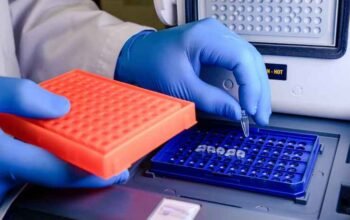
ELISA stands for Enzyme-Linked Immunosorbent Assay. It is a plate-based technique that is widely used in medical research. It helps detect and quantify molecular substances, like proteins, hormones, antibodies, and antigens, in biological samples. It relies on antigen-antibody interactions. This kit is known for its sensitivity, specificity, and quantitative accuracy. It is categorized into four formats: Direct, Indirect, Sandwich, and Competitive ELISA.
Traditionally, researchers use standard ELISA kits that come preconfigured for specific analytes under fixed conditions. They come with all necessary components, including pre-coated plates, antibodies, enzyme conjugates, buffers, and detection reagents. These kits are designed to follow a fixed protocol optimized by the manufacturer.
The manufacturers develop and test these kits for specific analytes, such as cytokines, hormones, or disease markers across commonly used species, like human, mouse, rat, etc. Moreover, each kit has a defined sensitivity and detection range suitable for specific sample concentrations. These kits are ideal for assays with common targets and sample types.
However, when it comes to the detection of rare biomarkers, uncommon samples, or specific assay conditions, standard ELISA kits may not be sufficient. At times, researchers turn to custom-made ELISA kits.
What are Custom-Made ELISA Kits?
Custom-made ELISA kits are created based on the specific needs and parameters of a research project. These kits are used to detect unique targets, uncommon samples, or specific assay conditions.
Researchers can choose any target analyte, including novel or rare biomarkers. Moreover, these kits can be customized for any species, including less common ones, including canine, bovine, avian, or plant.
Unlike standard ELISA kits, customized ELISA kits are ideal for difficult or unconventional samples, including tissue lysates, cerebrospinal fluid, saliva, and plant extracts. These assay formats for customized kits can be selected or modified based on experimental requirements.
Its sensitivity and detection range can be adjusted to detect low or high concentrations of the analyte. These kits don’t use standard reagents. Instead, they allow customization of antibody-antigen pairs, enzyme conjugates, and buffer systems for optimal performance.
These kits have very high consistency as all batches are produced under the same custom specifications. While the cost for customized kits can be high initially, they are cost-effective for large-scale or long-term projects.
Why Researchers Prefer Custom ELISA Kits Over Standard Kits?
Tailored to Specific Research Needs
Custom-made ELISA kits are designed around the researcher’s specific requirements. Standard ELISA kits are developed for general use and often target common species, sample types, or analyte concentrations.
However, research projects frequently deal with specialized conditions that standard kits cannot fully accommodate.
Custom kits allow scientists to define important parameters such as:
- Target analyte and detection range
- Sample type
- Species specificity
- Assay format
By adjusting these factors, the final kit provides optimized results for the intended application, whether it’s disease biomarker detection, vaccine development, or pharmacological research.
Greater Sensitivity and Specificity
Standard ELISA kits are designed for general use. So, sometimes, they can compromise on sensitivity and specificity. On the other hand, a custom-made ELISA kit is designed for a specific purpose. It can detect very small amounts of a target molecule, even when the concentration is extremely low.
Researchers can choose the best antibody-antigen pair, detection enzyme, and the right substrate system. This not only boosts the accuracy but also reduces background noise and minimizes cross-reactivity.
For example, a custom ELISA kit can be designed with stronger antibodies or extra amplification steps when it comes to studying a rare protein that exists in tiny amounts.
Compatibility with Unconventional Samples
Not all samples are the same. Blood or serum samples are simple, but others, like tissue lysates, cerebrospinal fluid, milk, or plant extracts, can be complicated. These samples may have interfering substances that can alter the test results.
Standard ELISA kits are usually tested only for common samples like serum or plasma. They may not work well with difficult or unusual samples. Custom-made ELISA kits can be adjusted for these complex samples.
Manufacturers can change the buffers, washing conditions, and assay steps to reduce interference and improve accuracy based on the research needs. So, a custom kit can work for many kinds of samples while providing consistent and trustworthy readings every time.
Flexible Detection Range and Dynamic Assay Design
Different research projects demand different detection ranges. For example, clinical diagnostic studies may need to detect trace amounts of a protein, while drug testing may require measurement of higher concentrations.
Custom ELISA kits can be fine-tuned to accommodate these variations. Researchers can adjust coating concentrations, antibody affinities, incubation times, and signal detection methods to ensure the optimal dynamic range for their specific application.
This flexibility helps in precise quantification across various sample concentrations and improves data quality and reproducibility in experiments.
Consistent Supply and Long-Term Reliability
One major challenge with standard ELISA kits is batch-to-batch variability or sudden discontinuation by suppliers. When a kit is no longer available or shows inconsistent results between lots, it can disrupt ongoing research projects and affect data reliability.
Custom-made ELISA kits eliminate this issue. Manufacturers produce and validate kits based on the researcher’s specifications. This helps ensure consistent quality control and continuous supply. The components, such as antibodies and buffers, are standardized for long-term use. This helps maintain data integrity throughout extended studies.
The Bottom Line
When it comes to research, accuracy, precision, reliability, and flexibility are crucial. Custom-made ELISA kits offer all these advantages and more. They can be customized as per the research needs, which helps provide better results. Moreover, they can handle complex samples and maintain long-term consistency.
So, researchers prefer custom ELISA kits over standard ones. If you are looking forward to using custom-made ELISA kits, make sure you choose a trustworthy supplier.