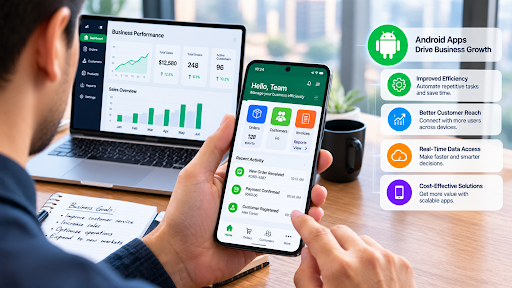
A delivery driver in a warehouse somewhere is scanning packages with a five-year-old Android phone that costs less than a decent pair of headphones, and the whole logistics operation behind that scan runs smoother because of it. Nobody’s impressed by this. Nobody writes articles about it. But it’s exactly why so many operations-heavy businesses keep working with an Android Application Development company instead of chasing something flashier, because Android’s reach into cheap, rugged, everywhere-available hardware solves real operational problems that a more premium platform simply doesn’t touch in the same way.
Android runs on a huge share of the world’s phones, and that fact alone changes what businesses can actually build. It’s not really about the operating system itself. It’s about the sheer range of devices running it, from a warehouse worker’s rugged handheld scanner to a field technician’s mid-range phone to a customer’s brand-new flagship, all of it Android, all of it reachable through one development approach.
Field service is probably where this shows up most obviously. Technicians out doing repairs, inspections, installations, need something durable and affordable enough that a company can hand it to a hundred employees without blinking at the cost. Android’s device diversity means a business can pick hardware suited to actual working conditions, drop-resistant, good battery life, sometimes built specifically for industrial use, rather than being locked into one manufacturer’s premium lineup.
Inventory and logistics run on this same logic. Barcode scanning, warehouse management, delivery tracking, all of it needs devices that can survive being dropped, get replaced cheaply when they inevitably break, and connect to whatever specialized hardware a warehouse already has. Android’s openness makes this kind of hardware integration considerably easier than platforms that keep tighter control over what can talk to what.
Retail has leaned into this too, mostly in ways customers never notice directly. Point-of-sale systems, inventory checks on the shop floor, customer-facing kiosks, a lot of it runs on Android because the hardware can be customized and priced to fit a retailer’s actual budget instead of forcing every location to buy the same expensive device regardless of what that specific store actually needs.
There’s a cost angle running underneath all of this that businesses don’t always say out loud but definitely factor into decisions. Building for Android tends to open up a much bigger potential user base globally, which matters enormously for companies operating in markets where Android dominates far more heavily than it does in, say, North America. A business trying to reach customers across several regions is often making a fairly practical calculation, not a philosophical one, about which platform actually reaches the people they’re trying to serve.
Development itself has gotten easier too, and testing plays a bigger role in that than people usually realize. Nobody wants to buy forty different physical Android devices just to check how an app behaves across different screen sizes and hardware specs, so a lot of teams lean on emulators instead, and comparing the Best Android Emulators becomes a genuinely practical exercise before committing to real device testing later in the process. Getting this part right early saves a lot of headaches once an app is actually out in the world running on devices nobody in the development team ever personally tested it on.
Customization is where Android quietly wins over a lot of businesses with specific operational needs. The platform’s openness lets a business build something tailored much more precisely to an unusual workflow than a more locked-down system would allow. A logistics company wanting deep integration with custom scanning hardware, or a retailer wanting a kiosk app that behaves nothing like a typical consumer phone experience, tends to find Android considerably easier to bend into shape.
None of this means Android is automatically the right call for every business. Companies whose customers skew heavily toward iPhone users, or whose priority is a tightly polished, premium consumer experience, often still lean the other direction. But for businesses whose priority is reaching the widest possible device range, keeping hardware costs down, or building something highly customized for an internal operational need, Android tends to be the more practical fit rather than an afterthought.
Maintenance is the part nobody budgets for properly at the start, and it matters more on Android than a lot of teams expect. With so many device makers and screen sizes in play, an update that looks fine on one phone can quietly break on another, so ongoing testing and patching tends to eat more time than businesses initially plan for. Companies that treat this as a one-time build, launch it, and walk away, usually end up with an app that slowly degrades across whatever new hardware shows up over the following year or two. The ones that budget for continuous upkeep from the start tend to avoid that slow decay entirely.
The businesses getting real value out of Android apps right now generally aren’t chasing the newest platform feature the moment it ships. They’re solving something concrete, cutting down manual paperwork in the field, speeding up how fast a warehouse worker scans a shipment, giving a retail associate a cheaper handheld tool instead of an expensive one. It’s unglamorous work, mostly invisible to anyone outside the company using it, and that’s sort of the whole point. The technology isn’t there to impress anyone. It’s there because it quietly makes an operation run a little better than it did before.