Compound interest is a concept that lies at the heart of many financial decisions, whether you’re borrowing money, saving for the future, or investing in assets designed to grow your wealth. But what is its true meaning, and how does it ultimately affect the returns on loans or investments? In this article, we will explore the meaning of compound interest, discuss its importance, delve into formulas for calculating it, and examine its impact on financial outcomes.
What Does Compound Interest Mean?
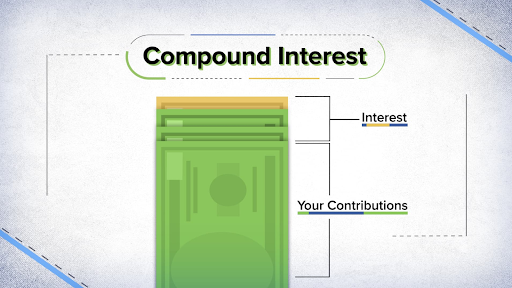
The meaning of compound interest is the interest added to the principal amount of a loan or investment over time, where the interest itself earns additional interest. In simple terms, it is “interest on interest,” allowing your money to grow at an accelerated rate. Unlike simple interest, which only applies to the principal balance, compound interest takes into account the interest that accumulates over time. This concept is pivotal for loans and investments alike. For loans, compound interest can lead to a significant increase in the total amount owed. For investments, it has the potential to exponentially increase returns over long periods, thanks to the effects of compounding.
How Does Compound Interest Work?
Compound interest is driven by a cyclical process:
- Accruing interest
- Adding interest to the principal
- Repeating the process
The rate at which money grows depends on several factors:
- Principal
- Interest rate
- Compounding frequency
- Time
What Is the Formula for Interest? (Compound Interest Formula Explained)
To calculate compound interest, the fundamental mathematical formula used is:
Compound Interest Formula:
A=P(1+r/n)ntA = P (1 + r/n)^{nt}A=P(1+r/n)nt
Where:
- A
- P
- r
- n
- t
Working Example:
Let’s assume you invest ₹10,000 for 5 years at an annual interest rate of 5%, compounded annually.
- P
- r
- n
- t
Plugging into the formula:
A=10,000×(1+0.05/1)1×5A = 10,000 \times (1 + 0.05/1)^{1 \times 5}A=10,000×(1+0.05/1)1×5
A=10,000×(1.05)5A = 10,000 \times (1.05)^5A=10,000×(1.05)5
A=10,000×1.27628A = 10,000 \times 1.27628A=10,000×1.27628
A = ₹12,762.80
Thus, the total amount is ₹12,762.80. The compound interest earned is: ₹12,762.80 – ₹10,000 = ₹2,762.80
Compound Interest in Loans
When borrowing money, compound interest works against you. Loan repayments include both the principal amount and the accrued interest over time. The longer you take to repay the loan, and the more frequently interest compounds, the larger your debt grows.
Key Points to Remember About Loans:
- Loans with compound interest build upon unpaid interest
- Higher interest rates or frequent compounding increase total repayment
- Quick repayment reduces compounding impact
Compound Interest in Investments
For investments, compound interest can be an incredibly powerful tool, allowing your money to grow faster than most expect. Whether investing in a savings account, stocks, bonds, or mutual funds, compounding accelerates wealth accumulation over time.
Key Benefits:
- Accelerated Growth
- Power of Time
- Reinvestment of Returns
Example:
Imagine you invest ₹20,000 in a 7% annual return account for 10 years.
A=20,000×(1.07)10A = 20,000 \times (1.07)^{10}A=20,000×(1.07)10
Total = ₹39,343
Interest earned = ₹19,343
Simple Interest vs Compound Interest: What’s the Difference?
It’s helpful to contrast compound interest with simple interest to understand why compounding is so impactful.
Simple Interest:
- Calculated only on principal
- No interest on accumulated interest
Example: ₹5,000 at 5% for 10 years earns ₹2,500
Compound Interest:
- Builds interest on principal + previous interest
Using the formula, total = ₹8,144.47
How Compound Interest Impacts Financial Decision-Making
Understanding how compound interest works can help you make informed decisions in borrowing or investing. Here are some practical takeaways:
1. For Loans
- Lower interest rates reduce compounding cost
- Annual compounding is cheaper than monthly/daily
- Early repayment saves interest
2. For Investments
- Start early
- Reinvest returns
- Contribute regularly
Advantages and Disadvantages of Compound Interest
Advantages:
- Encourages long-term growth
- Maximizes returns
- Rewards early investing
Disadvantages:
- Increases loan burden
- Can cause financial pressure
- Requires careful monitoring
Conclusion
Understanding the meaning of compound interest is vital for anyone navigating personal finances. Whether you’re taking out loans or growing your wealth through investments, compound interest can either be a financial burden or a powerful ally. The compound interest formula — A=P(1+r/n)ntA = P (1 + r/n)^{nt}A=P(1+r/n)nt — provides a useful tool for assessing future values and making educated decisions.
By recognizing how compounding impacts financial growth, you can take proactive steps to minimize loan repayment costs and maximize investment returns. Always remember that time is a critical factor in both cases. Acting early and strategically will help you leverage compound interest to your advantage and achieve your financial goals.