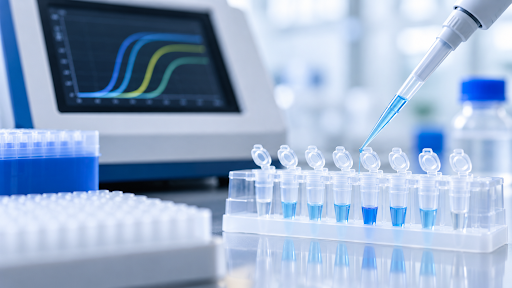
A DNA sample can appear pure and intact yet still produce weak amplification, unexpected bands, or no detectable PCR product. These outcomes can be frustrating when nucleic acid extraction appears successful, and the reaction follows the recommended protocol. However, DNA quality measurements alone cannot confirm that a sample is suitable for amplification. PCR performance also depends on inhibitors, primer specificity, reaction chemistry, and thermal cycling conditions. Understanding these factors helps researchers troubleshoot failed experiments systematically instead of repeating the same reaction without identifying the underlying problem.
Why Good DNA Quality Does Not Guarantee Successful PCR
1. PCR Inhibitors Can Interfere With Amplification
DNA purity measurements provide useful information about a sample, but they do not detect every substance that may interfere with PCR. Residual extraction reagents, salts, proteins, heme compounds, and other sample-derived substances can inhibit DNA polymerase activity or affect fluorescence-based detection.
The effect depends on the inhibitor, its concentration, and the assay. Even when a sample has an acceptable concentration and purity ratio, inhibitors may remain at levels sufficient to reduce amplification efficiency.
Researchers can investigate suspected inhibition by testing an appropriate dilution of the DNA template or improving purification. Dilution may reduce inhibitor concentrations, although it also decreases the amount of target DNA entering the reaction. An internal amplification control can provide additional evidence of inhibition when the experimental design supports its use.
2. Primer Design Can Limit Target Amplification
Primers determine which DNA region is amplified. Poor primer specificity, unsuitable melting temperatures, secondary structures, and primer-dimer formation can interfere with the intended reaction.
A primer pair may also perform inconsistently if its binding sites contain sequence variations or if the target region forms structures that limit primer access. These problems can occur even when the extracted DNA is intact.
Researchers should review primer sequences, assess potential off-target binding, and evaluate the expected amplicon. For quantitative PCR, amplification specificity and efficiency should be assessed using suitable validation methods rather than inferred from a single successful run.
3. Reaction Chemistry and Cycling Conditions Matter
PCR depends on the interaction of DNA polymerase, primers, nucleotides, buffer components, magnesium ions, and the thermal cycling program. Changes in magnesium availability can affect enzyme activity and primer binding, while inappropriate annealing temperatures may reduce specificity or yield.
Reaction conditions should be evaluated according to the assay and enzyme system. Researchers using ready-to-use reagents should follow the manufacturer’s protocol before modifying reaction components. Unnecessary changes to several variables simultaneously can make it difficult to identify the cause of failure.
How Can Researchers Troubleshoot Failed PCR Results?
Examine Controls Before Changing the Protocol
Controls help distinguish sample-related problems from failures affecting the reaction itself. A positive control can indicate whether the assay is capable of amplifying the expected target under the tested conditions. A no-template control helps identify possible contamination, while an extraction blank can reveal contamination introduced during sample preparation.
If the positive control fails, researchers should investigate the reagents, cycling program, instrument settings, and reaction setup. If the positive control works but the sample does not, template quality, inhibition, target abundance, or sequence compatibility may require closer examination.
Match the PCR Kit to the Experimental Objective
Different PCR applications have different requirements. Conventional PCR is commonly used to detect amplification products, whereas quantitative PCR monitors amplification during cycling. Reverse transcription PCR additionally requires conversion of RNA into complementary DNA before amplification.
When evaluating a PCR solution Kit provider, researchers should consider the intended application, target sequence, sample type, detection method, and instrument compatibility. The selected kit’s documented specifications and protocol should align with the experimental requirements. A reagent system suitable for one application should not automatically be assumed suitable for another.
Improving Reproducibility in PCR Experiments
A structured troubleshooting record can help identify recurring problems across experiments. Researchers should document DNA concentration, extraction method, reagent lot, primer sequences, cycling conditions, control results, and observed amplification patterns. Changing one variable at a time, where practical, makes it easier to evaluate the effect of each adjustment.
For quantitative assays, researchers should also examine amplification curves, replicate variability, and assay efficiency. For conventional PCR, expected product size and appropriate product analysis help determine whether amplification is specific.
Consistent sample handling, validated protocols, and suitable controls support more reliable interpretation. When results remain inconsistent, reviewing the entire workflow, from sample preparation to product detection, is more informative than relying on DNA purity measurements alone.
Conclusion
Successful PCR requires more than high-quality DNA. Inhibitors, primer design, reaction chemistry, cycling conditions, and assay selection can all influence amplification. By checking controls, investigating potential inhibition, and evaluating reaction conditions systematically, researchers can identify likely causes of failure and improve reproducibility. A methodical troubleshooting approach helps preserve valuable samples, reduce unnecessary repeat experiments, and produce more dependable molecular biology data.